
Deeeep.io
Game info
Deeeep.io is one of those free multiplayer browser games that takes a well-worn formula and finds a way to make it feel fresh. If you have ever played Agar.io or Mope.io, the basics will be immediately familiar: you start small, you eat things, you grow, and you try not to get eaten by something bigger. The twist here is that everything takes place underwater, and instead of absorbing colored dots as a featureless blob, you are working your way through an actual food chain of marine animals. That single thematic choice gives the game a surprising amount of personality. It is lightweight, accessible, and free to play in any browser, but the ocean setting and the animal-based progression system lend it more identity than you might expect from a quick lunchbreak distraction.
Climbing the Food Chain
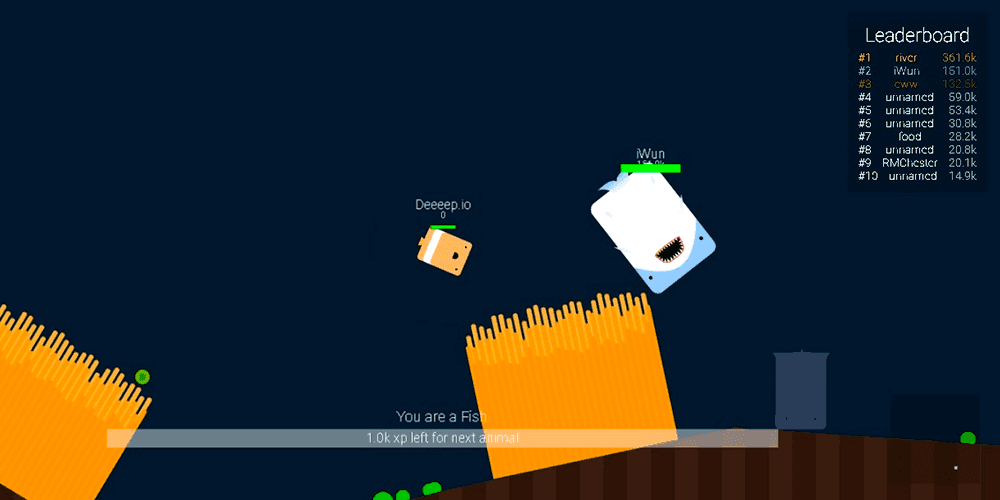
The controls are about as simple as they come. You move by aiming your mouse pointer and use the left mouse button to boost or perform an action. You start life as a tiny fish adrift in a very big sea, and your immediate goal is to collect food scattered around the environment while steering clear of anything that looks like it could swallow you whole. Gathering enough food lets you level up and evolve into a new marine creature, and each new form comes with its own specific abilities that meaningfully change how you play.
This is where the game quietly becomes more strategic than a typical browser arena title. Evolving into a seagull, for instance, grants you the ability to fly, opening up escape routes and hunting angles that are simply unavailable to anything stuck in the water. Choosing the jellyfish lets you poison attackers, turning you from easy prey into a dangerous nuisance. Each evolution is not just a stat upgrade but a shift in how you approach survival, hunting, and evasion. Experimentation is half the fun, and the roster is varied enough to reward repeated attempts.
That said, the climb can feel slow. Gathering enough food to reach the higher tiers takes time, and impatient players may find the mid-game grind a bit tedious. Death is punishing but not devastating — you lose half your accumulated XP rather than all of it, which softens the blow enough to keep you playing rather than closing the tab in frustration.
The Deep Sea, New Creatures, and Environmental Variety
Where the game really starts to distinguish itself is in its worldbuilding. A major update introduced the deep sea as a separate layer beneath the regular ocean map, accessible through creatures like the blobfish and the worm. This is not just a cosmetic change. The deep sea has its own terrain, its own food sources, and its own exclusive creatures, including the anglerfish and the manta. Certain animals can only survive in certain habitats, and venturing outside your native zone deals damage over time. If you evolve into a deep sea creature while swimming near the surface, you are protected from harm until you reach the depths, but you cannot eat food or deal damage along the way. These restrictions make the ecosystem feel layered and dynamic rather than like a flat, featureless arena.
The worm deserves special attention. It introduced a mechanic previously unexplored in the game: the ability to burrow into the ground. Once underground, the terrain becomes transparent from your perspective, and other players cannot see you at all — unless you type in chat, which pops a conspicuous white text box above your hidden position. It is a genuinely clever stealth mechanic that adds map interaction and mind games to a genre that rarely bothers with either.
The blobfish, meanwhile, is a creature designed for the crushing pressure of the deep ocean and struggles to survive at higher levels, reinforcing the idea that each animal is tied to a specific ecological niche rather than being a universally better version of the last one.
Smaller atmospheric touches round out the experience nicely. Schools of fish now drift through the upper levels of the ocean, adding movement and life to the world in a way that makes the environment feel less like a game board and more like an actual underwater habitat. It is the kind of detail that does not change the mechanics but quietly reinforces the game's charm and sense of place.