
Territorial.io

Game info
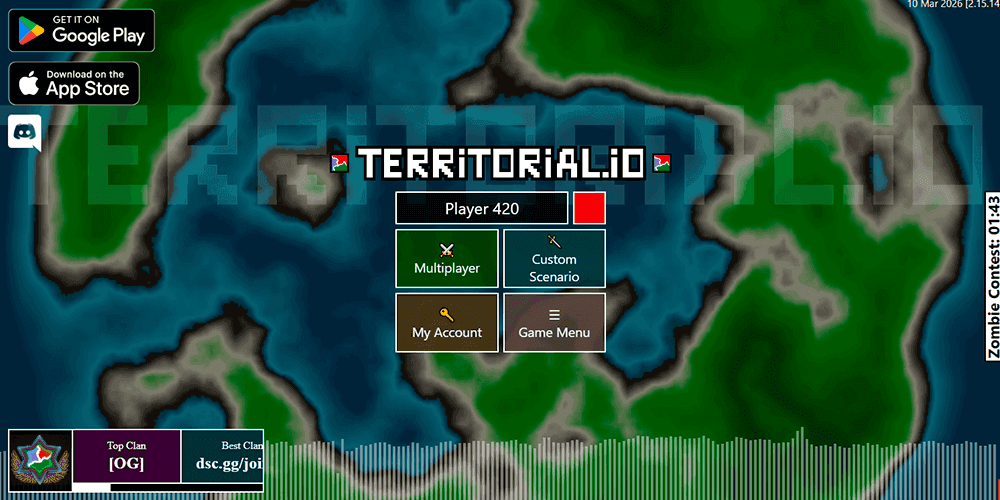
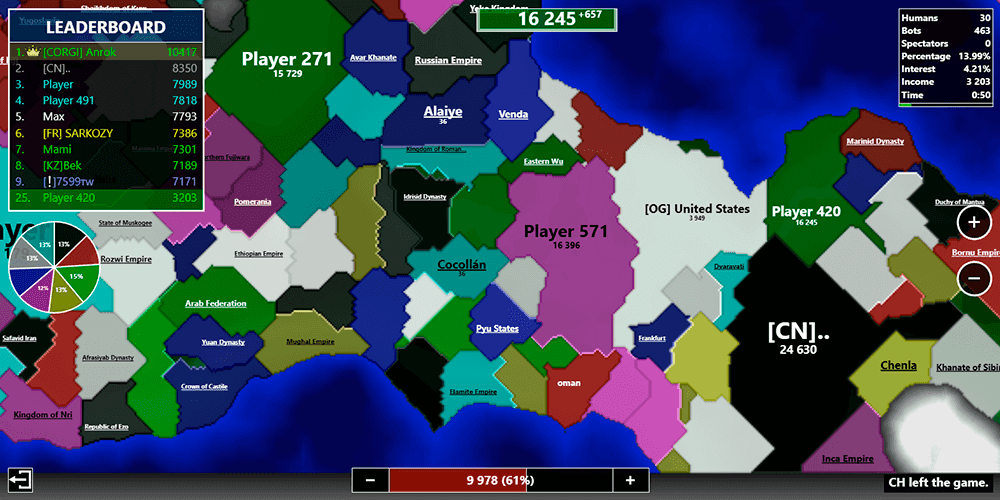
There is something immediately compelling about Territorial.io. Load a match, claim a sliver of land, and within seconds you are locked in a tense contest against dozens or even hundreds of other players, all fighting to paint the map in their color. Developed by David Tschacher and released in 2020, this browser and mobile strategy game strips the genre down to raw essentials: expand, manage your economy, outmaneuver your opponents, survive. Matches often wrap up in under five minutes, making it dangerously easy to queue just one more round. The presentation is bare-bones, little more than colored blobs spreading across a flat map, yet the decisions you face carry real weight. Territorial.io works precisely because it is so easy to enter and so much harder to master than its looks suggest.
Gameplay and Strategic Depth
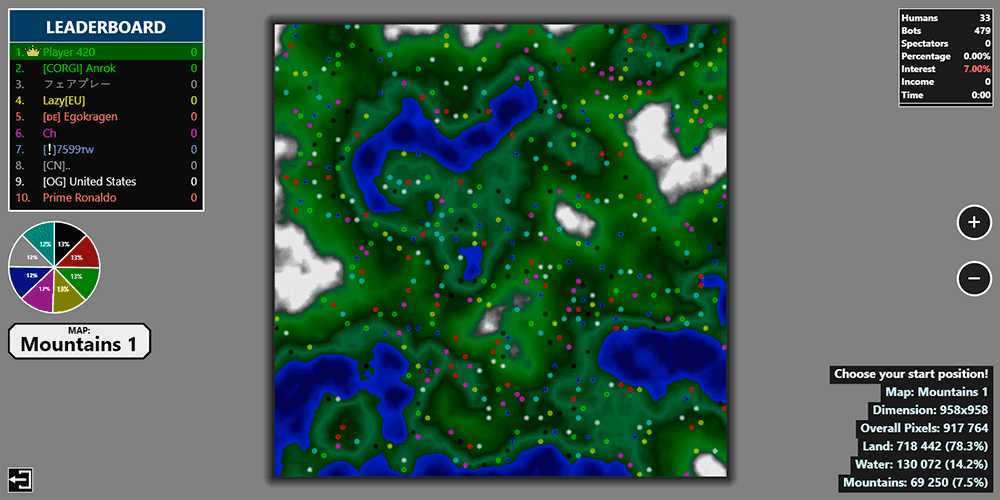
Every match follows a recognizable arc. The opening seconds are a land grab: you spread outward as fast as possible, racing to secure unclaimed territory before neighbors box you in. Direction and timing matter immediately. Expand too aggressively toward a strong opponent and you invite an early war you cannot afford. Spread too cautiously and you end up starved of the income your territory generates, unable to build the troop numbers needed to defend yourself later.
That income-troop relationship is the engine beneath everything. Your land produces resources, and resources let you grow your army, but spending recklessly leaves you exposed. The best players stockpile troops with patience, strike when a neighbor overextends or gets weakened by a fight on another front, and know exactly when to push and when to hold. Reading opponents is just as important as reading the map. A player sitting quietly on a large reserve of troops is far more dangerous than one who has been bleeding forces into constant skirmishes.
Different modes reshape the experience in meaningful ways. Free-for-all matches with up to 500 players are chaotic, unpredictable spectacles where survival often depends on geography and opportunism as much as pure skill. Team games shift the focus toward coordination, though the lack of a proper chat system means teamwork relies on instinct and observed behavior more than communication. One-on-one duels are where raw strategic ability shines brightest, removing the noise of massive lobbies and forcing players to outthink a single opponent in a clean test of efficiency and timing. Diplomacy exists, but only in a rudimentary form: emotes, flags, and the simple act of not attacking a shared border. These small signals create surprising tension, because a silent neighbor could be an ally or a predator waiting for the right moment.
Variety, Accessibility, and Friction Points
Territorial.io keeps its hooks in players through variety and convenience. The map pool ranges from real-world settings like Europe and full world maps to abstract arenas and auto-generated layouts, each one changing the strategic landscape enough to demand fresh thinking. Cross-platform availability means you can jump in from a browser on PC or through the mobile app on Android or iOS, and both versions deliver the full experience. That said, the PC browser version has a clear edge in visibility and control. A larger screen makes it easier to spot distant threats, and mouse input allows more precise troop management than tapping on a phone.
Not everything holds up under scrutiny, though. In large free-for-all matches, starting position can have an outsized influence on your chances. Spawning in a crowded cluster often means an early death before strategy even enters the picture, while a corner start offers breathing room that feels almost unfair. Match rhythms can grow repetitive over long sessions, since the expand-consolidate-attack loop, while satisfying, does not evolve dramatically from game to game. The limited communication tools are a double-edged sword: they keep things streamlined but also make team games frustrating when allies grief, go idle, or simply misread intentions. Toxic behavior in team modes is a genuine sore spot for the community. These are real drawbacks, and players who want deep diplomatic systems or varied win conditions may find the experience thin after extended play. Still, none of it erases the core competitive hook. When a match comes down to a tense border standoff, a perfectly timed attack, or a silent betrayal that flips the entire map, Territorial.io delivers a thrill that far outpaces its minimalist appearance.